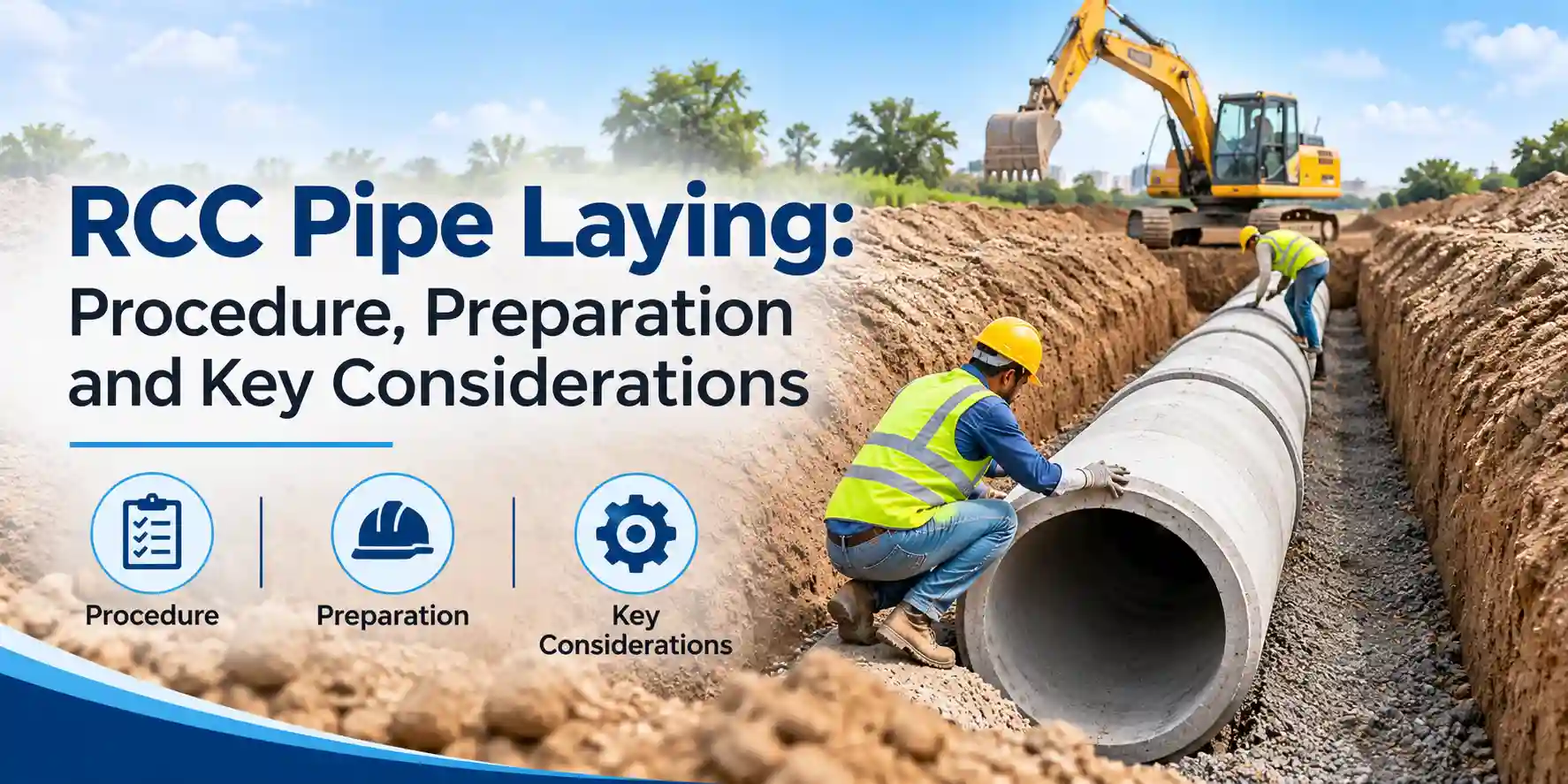
Reinforced cement concrete (RCC) pipes are widely used in infrastructure projects involving drainage, sewerage, stormwater management and culvert construction. Their installation requires careful planning because the performance of an underground pipeline depends not only on the pipe itself but also on how it is handled, positioned, connected and supported.
RCC pipe laying involves several construction activities, starting with site preparation and trench excavation and continuing through bedding, pipe placement, jointing and backfilling. Each stage must be carried out according to the approved engineering drawings, product specifications and site conditions.
An unsuitable installation arrangement can create alignment problems, uneven support or difficulties at pipe joints. Therefore, contractors and civil engineering professionals should understand the main stages involved before starting the work.
This guide explains the RCC pipe laying procedure, important installation considerations, and common mistakes to avoid during drainage and infrastructure projects.
What Is RCC Pipe Laying?
RCC pipe laying refers to the process of installing reinforced cement concrete pipes underground or within designated infrastructure structures to create a pipeline.
These pipes contain reinforcement within their concrete structure and are manufactured for different infrastructure applications. Their selection depends on factors such as the intended use, pipe dimensions, loading conditions, and project requirements.
RCC pipes are commonly used in:
- Stormwater drainage networks
- Underground sewerage systems
- Roadside drainage infrastructure
- Culverts and cross-drainage structures
- Industrial drainage arrangements
- Irrigation and water management projects
The installation method may vary depending on the pipe class, diameter, joint arrangement, ground conditions, and engineering design.
Step-by-Step RCC Pipe Laying Procedure
RCC pipe installation involves several connected stages. Following an organised sequence helps contractors maintain the required pipeline position and installation quality.
1. Site Inspection and Preparation
Before starting excavation, the project team should inspect the installation area and review the approved construction drawings.
The initial assessment should cover:
- Proposed pipeline alignment
- Required pipe diameter and class
- Existing underground utilities
- Ground and soil conditions
- Excavation access and working space
- Required pipeline gradient and levels
Any existing utility lines or site obstructions should be identified before excavation begins.
The installation team should also confirm that the required pipes, equipment and materials are available at the site.
2. Trench Excavation
Once the site is prepared, excavation can begin along the approved pipeline route.
The trench should provide sufficient space for pipe placement, jointing, and the preparation of the specified bedding arrangement. Its depth and width should follow the engineering drawings and relevant construction requirements.
During excavation, contractors should pay attention to:
- Maintaining the planned trench alignment
- Achieving the required excavation depth
- Providing appropriate trench support where necessary
- Managing groundwater or accumulated rainwater
- Preventing unnecessary disturbance to the trench bottom
Trench stability is particularly important where excavation takes place in loose soil or at greater depths. Suitable protective measures should be determined through the site risk assessment and construction method.
3. Preparation of Pipe Bedding
Pipe bedding provides the supporting layer on which the RCC pipes are placed.
Before positioning the pipes, the trench bottom should be checked for loose material, unsuitable soil, and irregular surfaces. The bedding material and its preparation should follow the approved project specifications.
Proper bedding is important because uneven support can create concentrated contact points beneath the pipe.
Contractors should ensure that:
- The bedding material matches the specified requirements.
- The prepared surface follows the designed alignment and level.
- The pipe receives the intended support.
- Joint locations and any required joint recesses are accommodated according to the installation detail.
The bedding arrangement may vary according to the pipe design, soil conditions, and project requirements.
4. Transportation and Handling of RCC Pipes
RCC pipes are substantial construction components, so their transportation and handling require suitable equipment and precautions.
Pipes should be checked before installation to identify visible cracks, damaged ends, or other defects that could affect their suitability.
During handling, contractors should:
- Use lifting equipment appropriate for the pipe dimensions and weight.
- Follow the manufacturer’s recommended lifting and handling procedure.
- Avoid dropping or dragging pipes.
- Protect pipe ends from impact damage.
- Position stored pipes on suitable, stable supports.
Damaged pipes should be assessed before installation rather than used without checking their condition.
5. Lowering and Positioning the Pipes
After the trench and bedding are ready, RCC pipes can be lowered into the excavation using suitable lifting equipment.
Each pipe should be positioned carefully to avoid damage to its body or jointing surfaces.
During this stage, the installation team should check:
- Correct pipe orientation
- Position along the approved pipeline route
- Required level and gradient
- Compatibility with the adjoining pipe
- Adequate support beneath the pipe
The pipes should not be forced into position in a way that damages their ends or disturbs the prepared bedding.
6. Checking Pipeline Alignment and Gradient
Maintaining the correct alignment and gradient is an important part of RCC pipe laying.
The pipeline should follow the levels and direction specified in the approved drawings. Where gravity drainage is involved, the designed gradient helps water move towards the intended outlet.
Contractors should use appropriate surveying and levelling equipment to check the position of each pipe during installation.
Particular attention should be given to:
- Horizontal alignment
- Invert levels
- Designed pipeline gradient
- Joint positioning
- Continuity between adjoining pipe sections
Regular checks during installation help identify deviations before additional pipe sections are laid.
7. RCC Pipe Jointing and Sealing
Once the pipes are positioned correctly, adjoining sections need to be connected using the specified jointing arrangement.
The joint type depends on the pipe design and project specifications. The mating surfaces should be checked before connection to ensure they are suitable for the intended joint.
The installation team should follow the manufacturer’s instructions for joint preparation, sealing materials, and assembly.
Important checks include:
- Clean and undamaged pipe ends
- Correct positioning of joint components
- Proper engagement of adjoining sections
- Consistent joint assembly
- Inspection for visible gaps or displacement
The objective is to achieve the joint arrangement specified in the project design. Jointing should not be treated as a step that can be completed independently of pipeline alignment.
8. Haunching and Backfilling
After pipe placement and jointing have been checked, the surrounding space can be filled according to the specified installation arrangement.
The material placed around the lower sides of the pipe, commonly referred to as haunching, helps provide support to the pipe. Backfilling then covers the remaining trench space.
During this stage, contractors should:
- Use the specified backfill material.
- Place material in the sequence required by the project specification.
- Provide suitable support around the pipe.
- Compact the material using approved methods.
- Avoid damaging or displacing the installed pipes.
Compaction equipment and procedures should be appropriate for the stage of backfilling and the pipe’s position. Heavy equipment should not be operated directly over insufficiently covered pipes.
The backfilling process should follow the approved construction method and applicable engineering requirements.
Important Factors Affecting RCC Pipe Laying Quality
Following the installation sequence is important, but several additional factors influence the quality of the completed pipeline.
Pipe Diameter and Class
RCC pipes are available in different dimensions and classes for different applications. The selected pipe should match the design requirements, including the expected loading conditions and installation environment.
For more information about pipe classifications, read our guide on Understanding NP2, NP3 and NP4 Concrete Pipes for Infrastructure Projects.
Soil and Ground Conditions
Ground conditions can influence excavation stability, bedding preparation and the support provided to the installed pipeline.
The construction team should assess the site conditions before finalising the installation arrangement. Where unsuitable ground or groundwater is encountered, the required measures should be determined by the project engineer.
Joint Compatibility
The jointing arrangement should be compatible with the selected pipe design. Incorrect joint preparation or assembly can affect the continuity of the pipeline.
Contractors should check the manufacturer’s instructions before starting the installation.
Pipeline Gradient
For gravity-based drainage applications, the specified gradient is important for maintaining the intended flow arrangement.
Incorrect levels can affect drainage performance. Therefore, checking the pipeline profile during installation is preferable to identifying problems after the entire trench has been completed.
Quality Checks During Installation
Quality inspection should take place throughout the installation process rather than only after the pipeline is completed.
Checks should cover pipe condition, bedding, alignment, jointing, and backfilling. Any deviation should be assessed and corrected according to the approved construction procedure.
Common Mistakes to Avoid During RCC Pipe Laying
Certain installation mistakes can create problems during construction or affect the performance of the completed pipeline.
1. Inadequate trench preparation
An uneven or unsuitable trench bottom can affect the support provided beneath the pipe. Prepare the trench according to the specified bedding arrangement.
2. Incorrect pipe handling
Improper lifting, dragging, or dropping can damage the pipe body and jointing surfaces. Use suitable equipment and follow handling instructions.
3. Uneven bedding support
Insufficient or improperly prepared bedding can create uneven support. Ensure the pipe is installed on the specified supporting layer.
4. Poor alignment
Deviations from the approved route or gradient can affect the pipeline arrangement. Check alignment and levels during each installation stage.
5. Incorrect joint assembly
Improperly prepared or assembled joints may not meet the intended connection requirements. Follow the specified jointing procedure.
6. Improper backfilling
Uncontrolled placement or unsuitable compaction can disturb the installed pipes. Follow the approved backfilling sequence and compaction requirements.
How to Select the Right RCC Hume Pipes for Your Project
Correct installation begins with selecting pipes that match the intended application.
Before purchasing RCC Hume Pipes, project teams should consider the following:
- Pipe diameter: Confirm the required internal diameter according to the pipeline design.
- Pipe class: Select the appropriate class based on the design and loading requirements.
- Application: Identify whether the pipes will be used for drainage, sewerage, culverts, or another infrastructure purpose.
- Construction specifications: Review the applicable standards and technical requirements.
- Product documentation: Check the manufacturer’s specifications and relevant quality documentation.
- Supplier capability: Consider manufacturing capacity, product availability, and the ability to meet project delivery requirements.
Himalaya Composites & Precast Pvt. Ltd. manufactures RCC pipes for infrastructure applications. For project-specific requirements, buyers can explore the company’s RCC Hume Pipes range and review the available product details.
Conclusion
RCC pipe laying is a construction process that requires careful attention to preparation, excavation, bedding, handling, positioning, alignment, jointing, and backfilling. Each stage contributes to the quality and suitability of the installed pipeline.
Contractors and infrastructure professionals should follow the approved engineering drawings, product specifications, and installation instructions throughout the work. Selecting the appropriate RCC pipe and maintaining quality checks during installation can help reduce avoidable construction issues.
For drainage, sewerage, and other infrastructure projects, explore Himalaya Composites & Precast Pvt. Ltd.’s RCC Hume Pipes and review the product specifications before making a selection.
Frequently Asked Questions
1. What is RCC pipe laying?
RCC pipe laying is the process of installing reinforced cement concrete pipes along a planned underground or surface pipeline route. It includes excavation, bedding, pipe placement, alignment, jointing, and backfilling.
2. What are the main steps involved in RCC pipe installation?
The main stages include site preparation, trench excavation, bedding preparation, pipe handling, lowering and positioning, alignment checks, jointing, and backfilling.
3. Why is bedding important during RCC pipe laying?
Bedding provides the supporting surface beneath the pipe. An appropriately prepared bedding arrangement helps distribute support according to the installation design and reduces the risk of uneven contact.
4. Why is pipeline alignment important?
Correct alignment ensures that the pipeline follows the approved route and level. For gravity drainage systems, maintaining the specified gradient is also important for the intended water flow.
5. How are RCC pipes joined during installation?
RCC pipes are connected using the jointing arrangement specified for the particular pipe design. The pipe ends, joint components, and sealing materials should be prepared and assembled according to the manufacturer’s instructions.
6. What should be checked before backfilling an RCC pipeline?
Before backfilling, contractors should check pipe positioning, alignment, levels, joint assembly, and the specified supporting arrangement. Any identified issue should be addressed before covering the pipeline.
7. Where are RCC Hume Pipes commonly used?
RCC Hume Pipes are commonly used in infrastructure applications such as stormwater drainage, underground sewerage, road culverts, and other water management projects. The appropriate pipe class and dimensions depend on the project requirements.