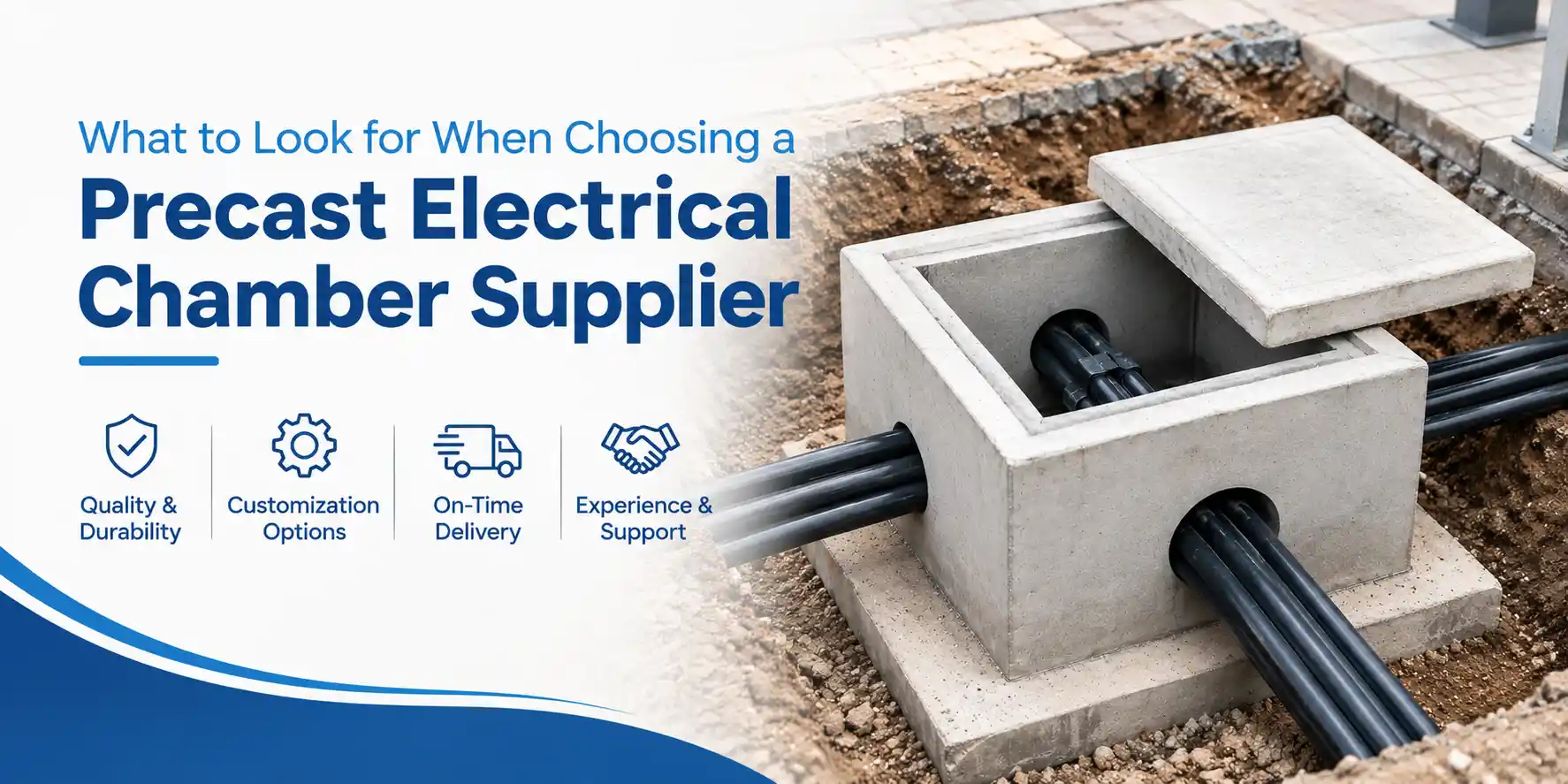
What to Look for When Choosing a Precast Electrical Chamber Supplier
Underground electrical infrastructure requires reliable chambers for cable jointing, distribution connections, inspections, and maintenance. While selecting the correct chamber design is important, choosing the right supplier is equally important because dimensional consistency, reinforcement, manufacturing quality, and supply capability can directly affect project execution.
When evaluating an RCC Electric Chambers Manufacturer, contractors, developers, and procurement teams should look beyond price alone. The manufacturer should understand underground utility requirements, provide appropriate chamber dimensions, maintain consistent production, and support the specific needs of the project.
Precast electrical chambers are widely used in underground electrical networks, DISCOM infrastructure, street lighting systems, smart city projects, and LT and HT cable connections. The following factors can help project teams make a more informed supplier selection.
1. Check the Manufacturer’s Experience
Manufacturing experience is one of the first factors to consider when selecting a Precast Electrical Chamber Manufacturer. Infrastructure products need to be produced according to defined dimensions and project requirements, making experience with precast manufacturing valuable.
A manufacturer familiar with different infrastructure applications can better understand requirements related to chamber size, cable arrangements, installation conditions and project quantities.
Himalaya Composites & Precast Pvt. Ltd. has been manufacturing infrastructure products since 2004 and has supplied products for more than 5,000 infrastructure projects across 25+ cities.
Experience alone should not determine supplier selection, but it provides useful context when combined with technical capability, quality management, and project support.
2. Evaluate the Available Chamber Sizes
Electrical infrastructure projects do not always use chambers of the same dimensions. Cable configuration, available installation space and the type of connection can influence the required chamber size.
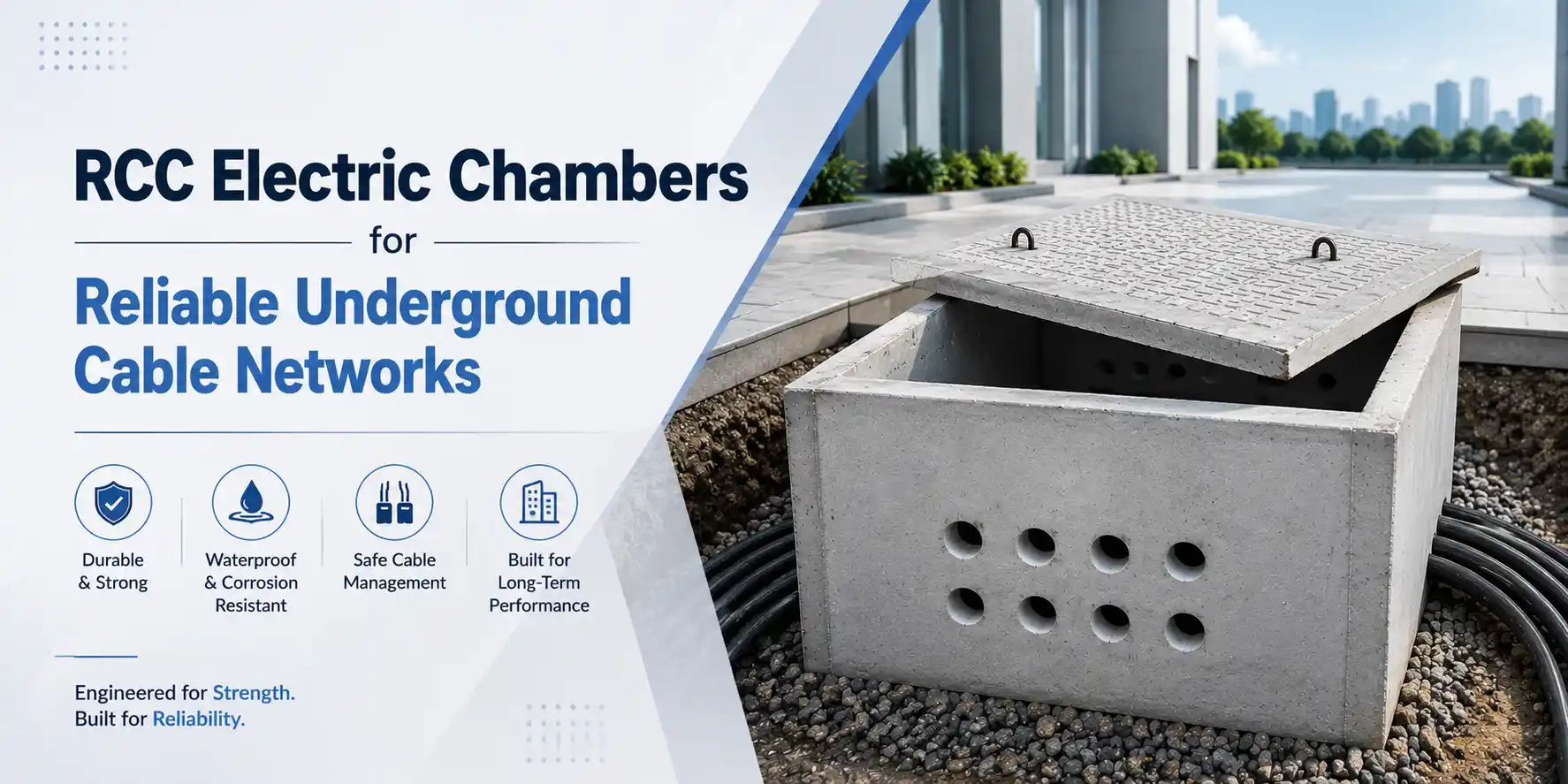
Himalaya’s RCC electric chambers are available from 320 × 320 mm to 750 × 750 mm, measured out to out. Available chamber heights or depths range from 190 mm to 500 mm.
Before placing an order, project teams should confirm:
- Required chamber dimensions
- Chamber depth
- Number and arrangement of cables
- Cable jointing requirements
- Available installation space
- Cover and frame requirements
Choosing an RCC Cable Chamber only by approximate dimensions can create problems during installation. Dimensions should therefore be checked against project drawings and actual utility requirements.
3. Confirm Reinforcement Requirements
Reinforcement is an important component of precast reinforced concrete chambers. It contributes to the chamber’s ability to perform according to its intended design and application.
Himalaya manufactures its RCC electric chambers with reinforcement as per standard.
When comparing suppliers, buyers should request the technical information applicable to the chamber they intend to purchase rather than assuming all precast chambers have identical construction.
This is particularly important for infrastructure procurement, where specifications may vary according to the project, installation conditions, and engineering requirements.
4. Look for Consistent Precast Manufacturing
One of the important advantages of precast construction is that chambers are manufactured before they reach the installation location.
Compared with conventional cast-in-situ construction, precast manufacturing can provide more consistent production while reducing the amount of construction activity required at the project site.
For projects requiring multiple Underground Electrical Chambers, dimensional consistency can also simplify planning and installation.
A supplier should therefore have appropriate manufacturing capability to produce chambers consistently according to the required dimensions and specifications.
Himalaya operates from a manufacturing facility of more than 1,99,000 sq. ft., supporting its wider infrastructure product manufacturing activities.
5. Check Cover and Frame Compatibility
A chamber is not a complete access solution without an appropriate cover and frame. The components should correspond with the chamber dimensions and intended installation.
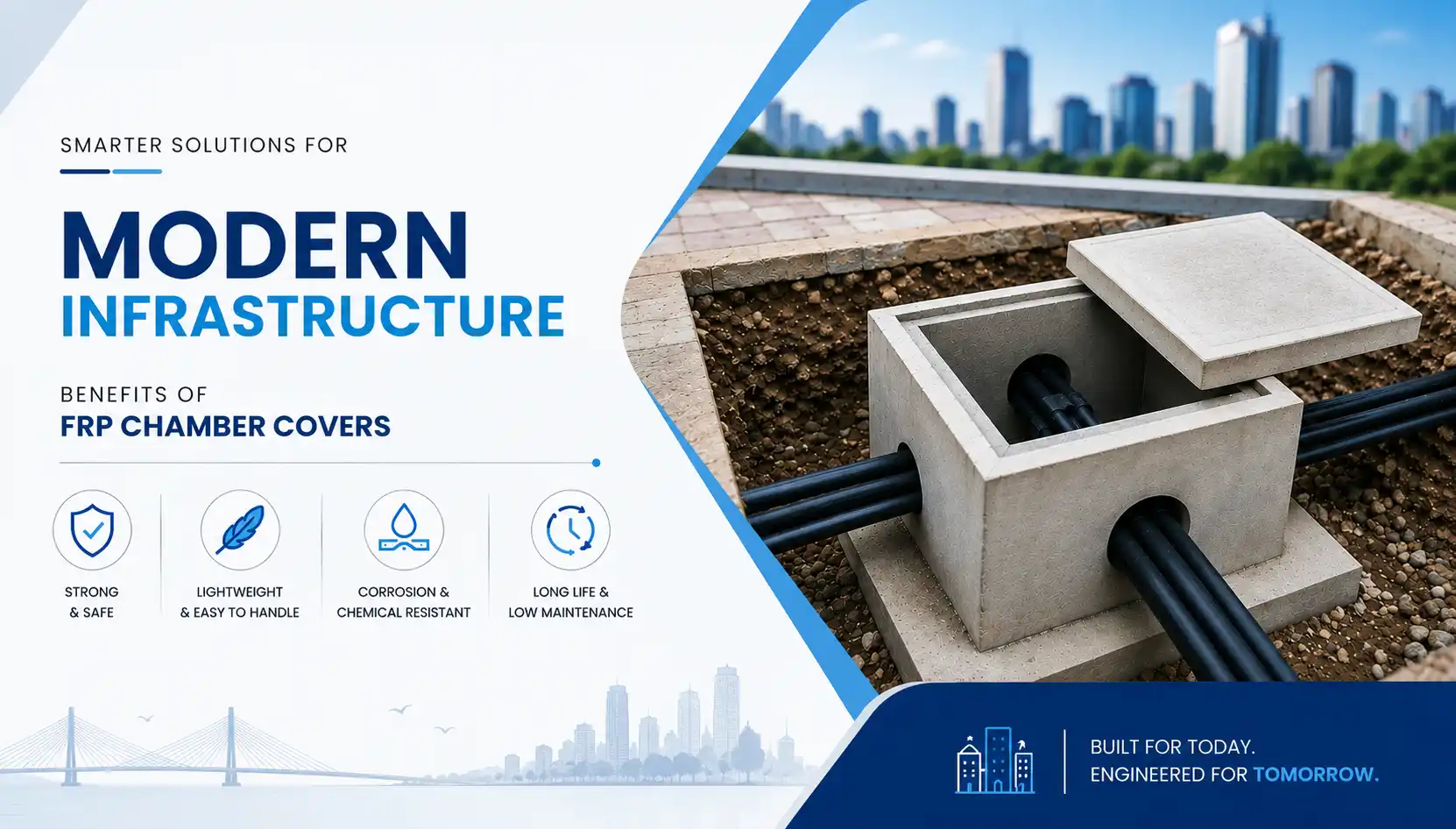
Himalaya’s RCC electric chambers can be supplied with matching covers and frames, helping provide installation-ready chamber solutions.
When discussing requirements with an RCC Electric Chamber Manufacturer, buyers should confirm:
- Chamber dimensions
- Required cover dimensions
- Frame configuration
- Access requirements
- Installation environment
- Project drawings and specifications
Sourcing compatible components can help reduce dimensional mismatches during installation.
6. Consider the Intended Electrical Application
The right chamber should be selected according to its actual function within the utility network.
Underground Electrical Networks
A Precast RCC Chamber can provide an accessible enclosure for underground electrical cable networks and utility distribution connections.
LT and HT Cable Joints
LT and HT cable jointing requires accessible underground spaces designed around the project’s cable arrangement. Chamber dimensions should therefore be confirmed according to the specific jointing requirements.
DISCOM Infrastructure
Electrical distribution projects may require chambers across multiple network locations. Consistency of supply and dimensions can become particularly important when significant quantities are required.
Street Lighting Junctions
Street lighting infrastructure frequently involves underground cable connections. Precast chambers can provide accessible points for these junctions.
Smart City Infrastructure
Smart city projects can involve extensive underground utility networks. Precast chambers can support organised access to electrical and related utility connections.
External Building Connections
Commercial, residential and institutional developments may require external underground electrical connections. Chambers can provide protected access points for these installations.
7. Assess Customisation and Project-Specific Support
Standard dimensions can meet many infrastructure requirements, but not every project follows the same design.
Before selecting an RCC Electric Chambers Manufacturer, determine whether the company can understand project-specific requirements and provide suitable solutions.
Himalaya provides custom sizes, designs and project-specific solutions across its infrastructure manufacturing capabilities.
For electrical chamber projects, buyers should provide accurate technical information, drawings and quantity requirements when discussing custom requirements. This allows the manufacturer to evaluate the required configuration before production.
Customisation should always be based on engineering requirements rather than modifying standard dimensions without considering the complete installation.
8. Review Quality Management
Quality consistency becomes particularly important when a project requires multiple precast components.
When comparing suppliers, procurement teams should examine whether the manufacturer follows a structured quality management process. This can support greater consistency across manufacturing, documentation and product supply.
Himalaya operates with an ISO 9001:2015 certified quality management system.
However, buyers should still verify the technical specification of the particular Electrical Cable Chamber being ordered. A company-level quality certification should complement, rather than replace, proper review of product dimensions, reinforcement and project requirements.
9. Consider Manufacturing and Supply Capability
Large infrastructure and utility projects can require products in significant quantities and across multiple project stages. Supplier capability therefore extends beyond manufacturing an individual chamber.
Buyers should consider whether the supplier can support:
- Required quantities
- Project schedules
- Multiple chamber configurations
- Custom requirements
- Consistent manufacturing
- Transportation and delivery planning
- Supply to the required project location
Himalaya provides pan-India supply with reliable delivery schedules and has experience serving infrastructure projects across multiple cities.
Discussing quantities and delivery schedules before finalising an order can help both the project team and manufacturer plan production effectively.
10. Compare Technical Capability, Not Just Price
Price is naturally an important part of infrastructure procurement, but selecting a supplier purely on the lowest quotation may overlook other factors that influence the project.
A meaningful supplier comparison should include chamber dimensions, reinforcement requirements, cover and frame compatibility, manufacturing quality, customisation capability, production capacity and delivery requirements.
Two quotations for apparently similar RCC Electric Chambers may not necessarily represent identical product specifications.
Providing the same drawings, dimensions, quantities and technical requirements to shortlisted manufacturers can make supplier comparisons clearer and more relevant.
Why Consider Himalaya for Precast Electrical Chambers?
Himalaya Composites & Precast Pvt. Ltd. has been serving infrastructure requirements since 2004. Its precast electrical chambers are designed for underground electrical cable networks, cable jointing systems, telecom infrastructure and utility distribution projects.
Available RCC electric chambers range from 320 × 320 mm to 750 × 750 mm out to out, with depths from 190 mm to 500 mm. Reinforcement is provided as per standard, and chambers can be supplied with matching covers and frames.
The company’s wider capabilities include project-specific solutions, an ISO 9001:2015 certified quality management system and pan-India supply.
These capabilities can be evaluated alongside the project’s engineering specifications when selecting an RCC Electric Chambers Manufacturer.
Conclusion
Choosing a precast electrical chamber supplier requires more than finding a manufacturer offering the required product. Project teams should evaluate manufacturing experience, available dimensions, reinforcement, quality management, cover and frame compatibility, customisation capabilities and supply reliability.
A suitable RCC Electric Chambers Manufacturer should also be able to understand the intended application, whether the chambers are required for LT or HT cable joints, DISCOM infrastructure, street lighting, smart city developments or underground utility networks.
Himalaya Composites & Precast Pvt. Ltd. provides precast RCC electric chamber solutions for different infrastructure requirements. Contact Himalaya with your chamber dimensions, application, quantity and project specifications to discuss a suitable solution.
Frequently Asked Questions
What should I check before choosing an electrical chamber supplier?
Check the manufacturer’s experience, available dimensions, reinforcement specifications, manufacturing consistency, quality management, cover and frame options, customisation capability and delivery capacity.
What sizes of precast electrical chambers does Himalaya manufacture?
Himalaya’s RCC electric chambers are available from 320 × 320 mm to 750 × 750 mm out to out, with chamber depths ranging from 190 mm to 500 mm.
Can precast chambers be used for LT and HT cable joints?
Yes. Himalaya’s RCC electric chambers are intended for applications including LT and HT cable joints, subject to the specific engineering and installation requirements of the project.
Are covers and frames available with the chambers?
Yes. Himalaya can supply its RCC electric chambers with matching covers and frames for complete installation readiness.
Where are RCC electric chambers commonly used?
Applications include underground electrical networks, DISCOM distribution infrastructure, smart city projects, street lighting junctions, LT and HT cable joints and external building electrical connections.